

MANZINI – A partnership between the Simama Project and the Eswatini National Agricultural Union (ESNAU) is giving young farmers something many struggle to find: affordable finance, and the skills to use it well.
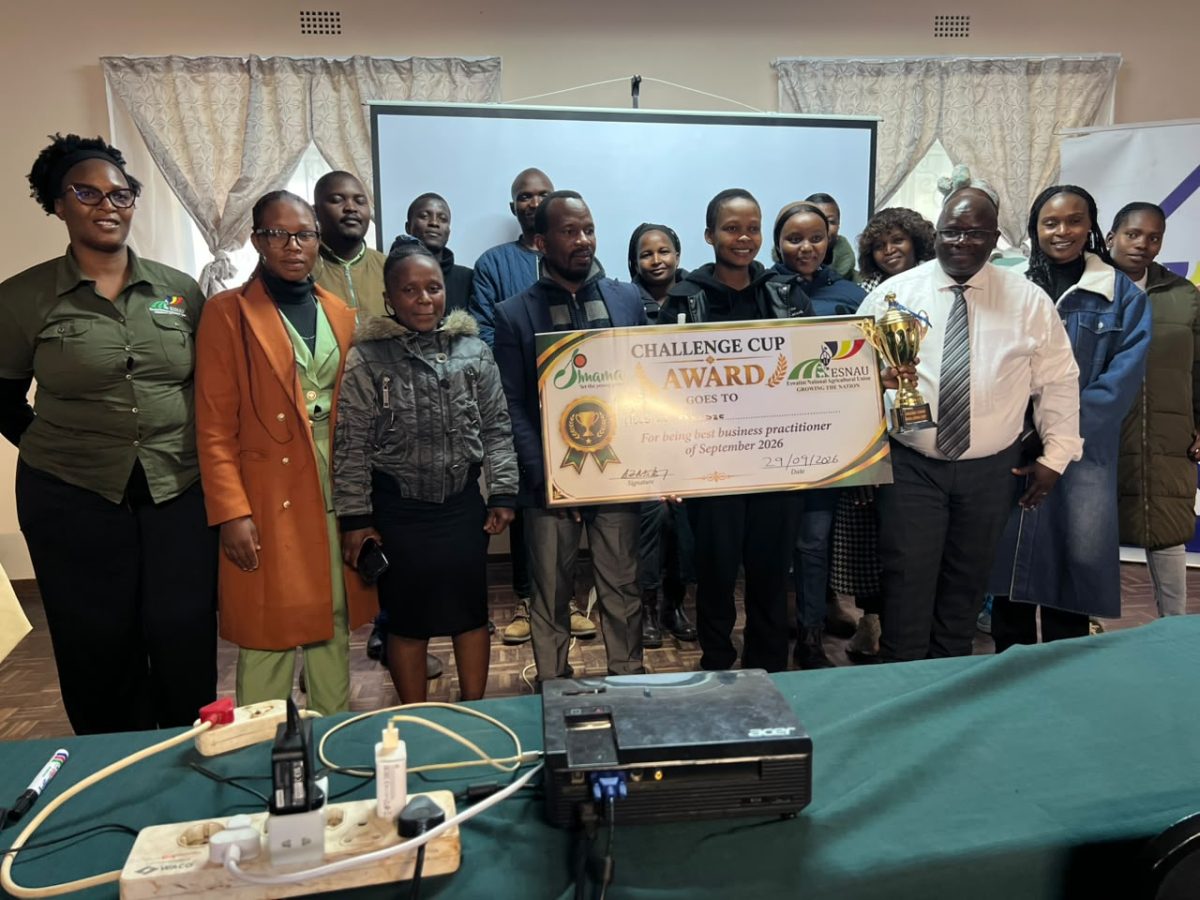
At a farmer engagement held on Tuesday, 29 September, the non-governmental organisation trained young farmers on agricultural financing, awarded zero-interest loans to new beneficiaries, and presented its first-ever Simama Project Challenge Cup to 26-year-old Neliswa Fakudze of Mankayane, a piggery and poultry farmer recognised for disciplined farm management and on-time loan repayment.
ESNAU Officer Phumzile Manyatsi commended the partnership, saying Simama’s support is helping to secure a brighter future for young people who have chosen agriculture as a business.
Finance with a pathway to growth
Simama Project Director Acorn Mndzebele said the organisation was established to support young entrepreneurs with finance, either to start new businesses or to expand existing ones.
“The objective of the organisation is to see Eswatini have people who are able to support themselves through the small businesses they are running today,” Mndzebele said.
Through the ESNAU partnership, young farmers submit proposals outlining what they need to start or grow their enterprises. Successful applicants receive zero-interest agricultural loans starting from E10,000, which they use to buy the materials and inputs their businesses require.
Farmers who use their financing properly and repay on time qualify for further loans. This lets them expand step by step rather than depending on once-off funding.
“Our objective is to ensure that their businesses are sustained and growing,” Mndzebele said.
Diversify to survive shocks
Beyond finance, Simama encourages beneficiaries to diversify. Mndzebele said a single enterprise leaves a farmer exposed to shocks such as disease outbreaks, which often discourage young people from continuing.
“If you are doing gardening, there are outbreaks that can come and affect that business, and you find that most people feel discouraged. But if the person has another business that is separate, they will be able to get support from the other business,” he explained.
Support not limited to ESNAU members
While the programme works closely with ESNAU, Mndzebele said Simama’s support is open to other young farmers who come forward with proposals.
The organisation does not turn away applicants whose proposals are weak. Instead, it helps them improve their proposal writing, a skill that also prepares them to approach banks and other financial institutions.
Tuesday’s training covered loan applications, business plans and proposals, farm finance and loan management, record-keeping, and building commercially sustainable agricultural enterprises.
A trophy that keeps moving
The highlight of the day was the inaugural Simama Project Challenge Cup, a rotating award designed to motivate farmers to run their enterprises well.
“It is a challenge cup because the person who wins it keeps the trophy for three months. After three months, there will be another award, and the trophy will go to the next winner,” Mndzebele said. “We wish the person who won it today to come and hand it over to the next farmer who wins.”
The award carries a E2,000 cash prize for the winner’s personal use, with no conditions on how it is spent.
Winners are selected on set performance indicators. These include monthly reporting to Simama with photographs of the project, being available and compliant during monitoring visits, and showing integrity within the business and the community.
“If a person is not trustworthy within the community, even the people will not support that business,” Mndzebele said. “Reporting and monitoring time is where we are able to see most of these things.”
From nine piglets to a growing enterprise
Fakudze’s journey shows what the programme is trying to achieve.
She started her piggery on 23 March 2024 with nine piglets bought for E650 each. She later moved into breeding, buying gilts from Mpisi Breeding Station, and some of her sows now produce litters of up to 14 piglets. She estimates her initial investment at about E30,000, excluding feed and transport. She financed it partly through her broiler business and with support borrowed from family and friends.
Today she runs her piggery at her parental home in Mankayane alongside a broiler operation at Mkhondvo in rented poultry houses. She is now expanding into animal feed and farm equipment, with a long-term goal of owning her own feedlot.
Her progress has not been without challenges. High feed-transport costs, limited reliable transport and customers who delay payment have all tested the business. Fakudze credits careful feeding, biosecurity, clean water, hygiene, regular deworming and proper housing for keeping her pigs productive.
Mndzebele said what set her apart was how she managed the business behind the animals. She kept records, reported regularly, repaid her financing on time and qualified for another loan to expand.
“She is a passionate young person who is willing to see her business grow, and we can see it is growing rapidly,” he said. “She deserved to win this trophy, and we believe she will take good care of it and keep growing her business.”
Fakudze’s advice to other young farmers is practical: do not wait for huge capital. Start with what you can manage, keep proper records, keep learning, reinvest and grow gradually.
More than farming
Agriculture is one of three areas of Simama’s work. The organisation also runs community support programmes, including building houses for needy households. Its healthcare programme provides transport to medical facilities, pays hospital fees and buys medication for sick people who cannot afford care.
How to reach Simama
Simama Project’s offices are at Ngculwini area, near Hope Preschool, outside Manzini. The organisation can be contacted at simamapr@gmail.com or on 7652 0178