
BY: PHESHEYA KUNENE | EDITOR
EZULWINI — Eswatini’s traditional vegetable farmers have been handed something they have long needed: a clearer route to the consumer.
The Taiwan-supported TAVI Phase II programme has begun moving professionally packaged amaranth, locally known as imbuya, pumpkin leaves, umbhidvo wetintsanga, and okra, mandwandwe, into selected supermarkets, potentially transforming crops long associated with household gardens and informal trade into mainstream commercial products.
The Traditional African Vegetables Retail Market and Consumer Promotion Activities were launched at Happy Valley Hotel in Ezulwini on Friday, bringing farmers, retailers, government agencies and development partners together around what is increasingly becoming a business proposition rather than simply a nutrition project.
For farmers, that distinction matters.
Previous TAVI market assessments presented this year put the combined annual market for the three priority vegetables at more than E12.2 million. Pumpkin leaves were estimated to account for demand of 254 160kg worth about E7.6 million, amaranth 133 200kg worth about E4 million and okra 18 960kg worth approximately E570 000.
The opportunity now is to convert that potential demand into actual orders for farmers.
SUPERMARKET DOOR OPENS
Ten selected retail outlets are participating in the initial rollout, including outlets operated by SPAR and Boxer as well as Save More Mpaka and Thubelihle Store in Nhlangano.
That changes the commercial equation.
Instead of relying mainly on neighbours, informal markets, schools and occasional buyers, participating farmers could increasingly produce for organised retail channels where traditional vegetables are packaged, displayed and marketed alongside established fresh produce lines.
World Vegetable Center says TAVI Phase II, which runs from 2025 to 2027 in Eswatini, Kenya and Tanzania, is explicitly designed to scale earlier work to improve income, nutrition and climate resilience.
The foundations are already there.
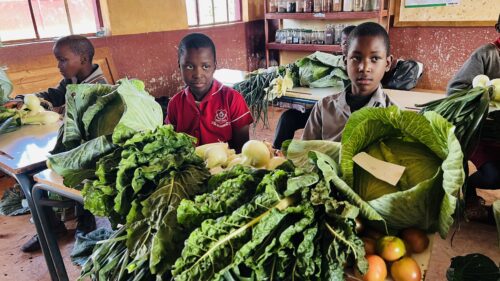
During the earlier phase of TAVI in Eswatini, more than 5000 farmers were trained and 103 champion farmers, 68 of them women, were selected to supply eight pilot schools. By January 2023 farmers had sold 2026kg of leafy vegetables at E30/kg, generating E60 780.
The latest retail push is therefore a significant step up: from proving that farmers can grow and sell traditional vegetables to testing whether they can supply a modern retail market consistently.
FARMERS SAY: WE ARE READY
Farmers at Friday’s launch said they were ready to supply the country.
That confidence will now be tested by the unforgiving economics of fresh produce.
A supermarket does not only need vegetables. It needs them fresh, clean, correctly handled, packaged, in predictable volumes and delivered when promised.
A farmer may produce excellent imbuya in rural Shiselweni, for example, but the commercial value falls rapidly if the vegetables cannot reach a retailer in Mbabane, Manzini or Matsapha in good condition.
That is why farmers participating in the discussions proposed establishing strategically located pack houses closer to production areas.
Such facilities could allow produce from several farmers to be aggregated, sorted, prepared and dispatched to retailers instead of every smallholder attempting to solve the logistics problem alone.
The proposal goes to the heart of the next phase of TAVI.
Growing the vegetable is no longer the only challenge. Getting it from the soil to the shelf while it is still fresh is becoming just as important.
World Vegetable Center itself lists food safety and post-harvest loss reduction among the areas covered by TAVI Phase II, with emphasis on maintaining vegetable quality across the value chain.
RETAILERS WANT RELIABLE SUPPLY

Retailers have raised the other side of the equation: logistics.
They want a proper supply system capable of delivering fresh produce consistently and keeping shelves stocked.
For farmers, that should be read as both an opportunity and a warning.
Retail access can create demand, but an empty shelf does not make money.
If consumers discover imbuya through the campaign this week but return later to find none available, the project risks losing the very demand it is trying to build.
Farmers will therefore have to coordinate planting and harvesting rather than everybody producing the same crop at the same time.
Pack houses will have to handle produce quickly. Transporters will have to deliver reliably. Retailers will have to manage stock. And farmers will increasingly need to understand how much the market requires before planting.
This is precisely the kind of market linkage Eswatini has been trying to strengthen. NAMBoard’s Encabeni Fresh Produce Market, for example, was established to facilitate market access by connecting farmers with different market channels and matching production capabilities with market requirements.
TAVI now takes that logic directly into the supermarket.
FROM ‘POOR MAN’S FOOD’ TO COMMERCIAL CROP
There is also a cultural hurdle to overcome.
World Vegetable Center notes that crops including amaranth and okra were historically dismissed in some communities as “poor man’s food”, despite their importance in local diets. TAVI has spent several years trying to change that perception through production support, cooking demonstrations and consumer education.
In 2024 alone, WorldVeg says three TAVI mobile kitchens reached more than 40 000 people through promotional events, while wider public engagement reached more than 120 000 people.
The supermarket campaign takes that consumer battle into a different arena.
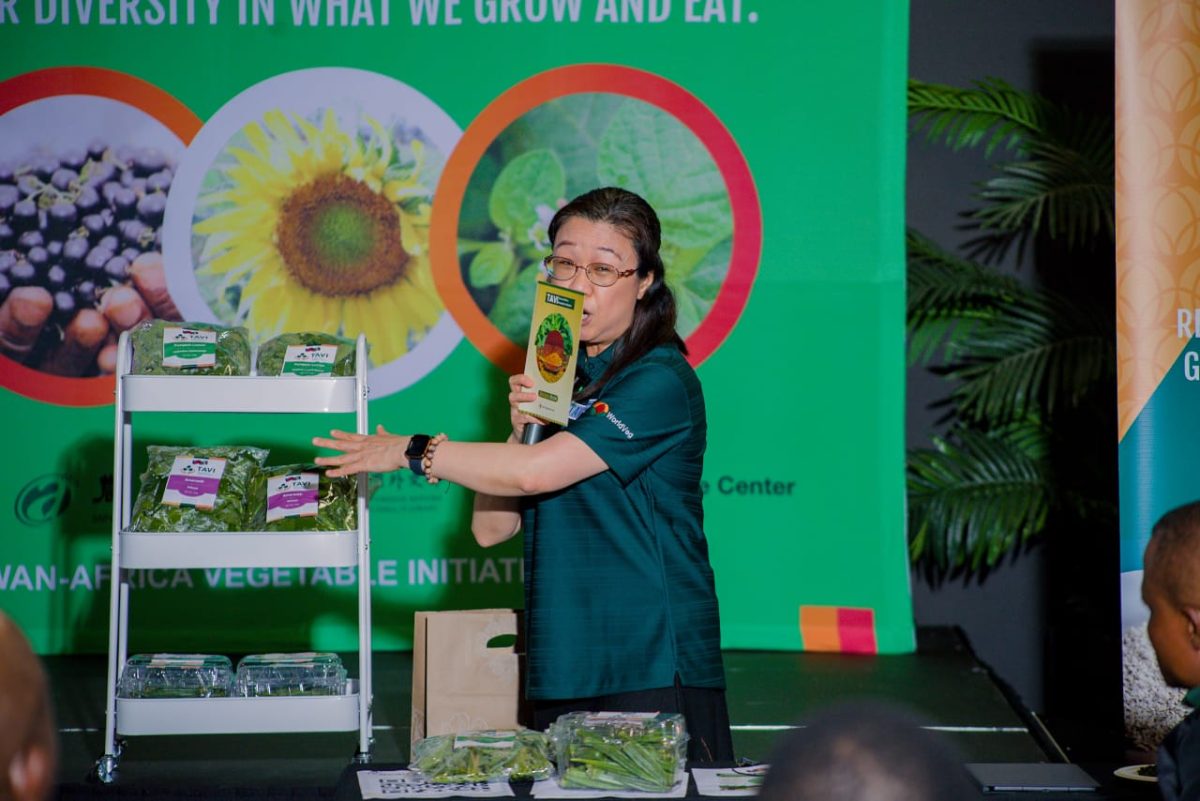
TAVI Project Manager Dr Yuan-Li Sophia Chan demonstrated at Friday’s launch how the packaged vegetables will appear in participating shops.
Consumers will not simply encounter packets of unfamiliar greens.
The TAVI shelves will be supported by food tastings, educational information and recipe materials showing shoppers how vegetables such as amaranth and okra can be prepared.
That matters commercially.
Putting vegetables on a shelf creates availability. Teaching consumers what to do with them can create demand.
RESTAURANTS BECOME ANOTHER BUYER
TAVI is also working beyond supermarkets.
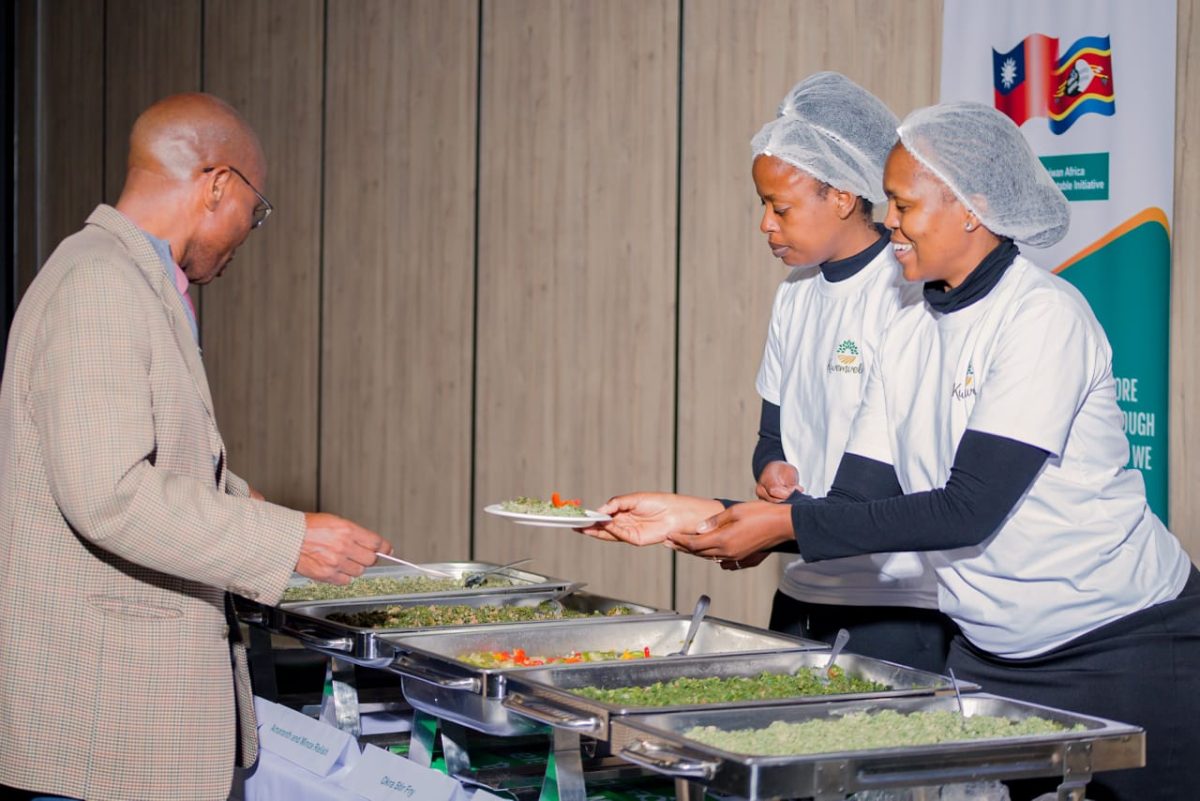
Restaurants participating in the initiative have received training in preparing traditional African vegetables, opening another potential market for farmers.
Siphindzile Ndzinisa, founder of Kudla Kwesintfu Restaurant, said her business was among those benefiting from the programme and had received recipe training.
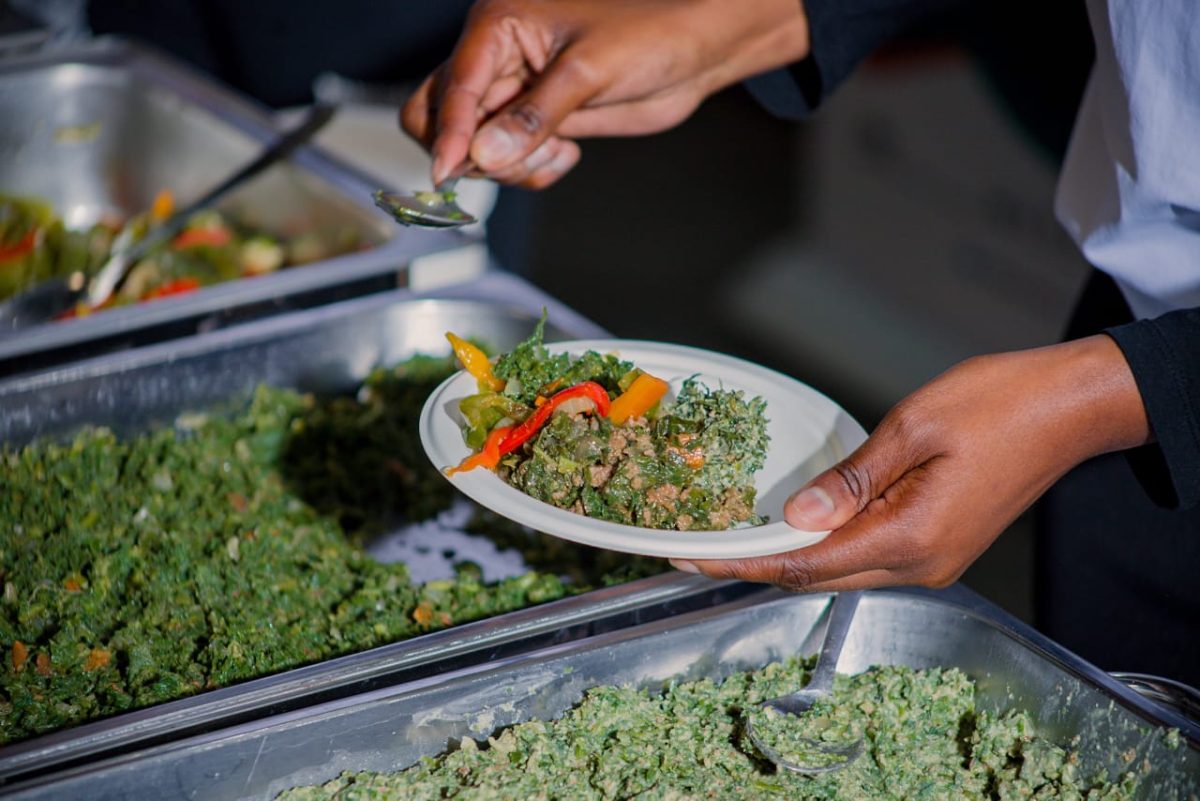
Her restaurant prepared some of the traditional vegetable dishes tasted during the launch.
For farmers, restaurants represent an important additional route to market. A crop no longer has to depend entirely on households buying it raw. It can enter the hospitality industry as an ingredient and return to the consumer as a prepared meal.
That is how a vegetable begins becoming a value chain.
FARMERS COULD BE THE BIGGEST WINNERS
The biggest prize from TAVI’s commercialisation drive ultimately sits back in the field.
If consumer demand grows, farmers gain another reason to put land under traditional vegetables. If restaurants begin buying regularly, another market opens. If retailers expand beyond the first 10 outlets, volumes could rise further.
And unlike a once-off agricultural promotion, a functioning retail supply chain can generate repeat demand.
The opportunity is particularly significant because TAVI has already spent years developing the production base.
WorldVeg says its earlier work supplied farmers with seed kits and technical training while supporting champion farmers to supply schools, orphanages and neighbourhood care points.
Phase II now has to answer the commercial question: can those farmers graduate from project-supported production into businesses capable of serving paying markets at scale?
FROM ESWATINI’S FIELDS TO BIGGER MARKETS
Government believes the opportunity could eventually stretch beyond domestic supermarket shelves.
Speaking on behalf of Agriculture Minister Mandla Tshawuka, Nikiwe Dlamini said traditional vegetables such as imbuya and mandwandwe have untapped potential to showcase Eswatini’s flavours, culture and food heritage.
That ambition will require more than good storytelling.
Formal markets reward farmers who can deliver consistently. Retail expansion will therefore depend on production planning, aggregation, food safety, packaging, cold-chain or appropriate fresh-produce handling, transport and reliable market information.
TAVI has opened the supermarket door.
The next question is whether Eswatini’s farmers and fresh produce supply chain can walk through it together.
For farmers, the prize is no longer merely recognition for crops their families have grown for generations.
It is the possibility of turning those crops into regular commercial orders, supermarket sales and sustainable farm income.